Geometry and Films

The Bouba-Kiki Effect is a psychological phenomena that has been studied since the 1920’s. It’s a synesthesia test of sorts that documents a majority of people matching certain words to shapes. For example, many matched the word “Kiki” to the more jagged image on the left while “Bouba” was frequently matched to the more rounded shape on the right.

The study suggests certain shapes do have an unconscious effect on how we view on image.

Circles usually represent allies, or “good” characters. Look at The Princess and the Frog (2009), two characters that serve as allies to the protagonists are designed with circles. The obvious one is the firefly, the less obvious is a creature not usually associated with soft edges, an alligator. The stomach is the most noticeable along with the rounded neck area. There are even circles on the pads of his feet and hands.
It’s not as noticeable in films that aren’t animated because we’re dealing with actual humans and the way they already look. The shapes are still there though if you’re paying attention. Look at Marvel characters Iron Man and Captain American. The circle is in the center of Tony Stark’s chest. Rodger’s shield is probably the most memorable and consistent thing about his suit.

It’s not as noticeable in films that aren’t animated because we’re dealing with actual humans and the way they already look. The shapes are still there though if you’re paying attention. Look at Marvel characters Iron Man and Captain American. The circle is in the center of Tony Stark’s chest. Rodger’s shield is probably the most memorable and consistent thing about his suit.
Films are all about the transformation of a character, or characters, though- both emotionally and sometimes physically. One example comes from Moana (2016) and the character Te Fiti. If you haven’t seen the film I’m sorry, but this is a spoiler. Te Fiti is the “villain” Moana and Co. face in the climax of the film. We learn moments later that Te Fiti is actually the goddess responsible for creating life in their world. She transforms from a monster with jagged edges to a softer, rounded design. This change is most noticeable in the cheeks.


While circles are associated with the good, it can be argued that triangles are paired with the bad. It should be noted that triangles could also depict a change or show a great power too. Look at Yzma from The Emperor’s New Groove (2000). The more you look the more triangles you can spot. I’ve identified all the ones I noticed. Yzma is a powerful character in the film as well as the antagonist. She’s smart (somewhat) and manages to take the throne from Kuzco for a majority of the film. The use of so many little triangles created a more jagged character, thus making here seem more dangerous.
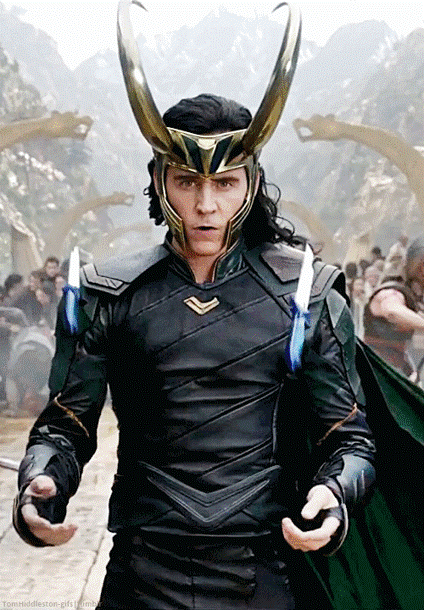
Another distinct use of the triangle is horns which appears frequently with demonic or evil characters. Think of Maleficent, the beast from Beauty and the Beast (he’s not a bad guy but he is still considered dangerous and evil before he becomes smitten).
Again, the shapes aren’t as apparent in live action films but it is still there. Let’s look again at the Avengers but this time with the character Loki. His costume features horns. His crown also contains a small triangle in the center over his forehead and in certain parts of his suit.

Squares can relate to a character’s stubbornness. It also shows a character is slow to change. Look at Carl (the old man) from Up (2009) and Ralph from Wreck-It Ralph (2012). At the beginning of their films both characters are set on an idea which sparks the adventure for the rest of the story and they’re stuck with the idea until almost the last act of the movie where they give in and let go of their original goals for their new friends.
Carl wants to take his house to a place he and his wife dreamed of while Ralph wants to be seen as a hero and earn a medal as proof of it. Carl’s face is a literal square. Ralph’s hands are blocky and his shirt is plaid which is a square pattern.

Squares can also be used to create a sense of entrapment, giving the sense that the character(s) are trapped. Back in Wreck-It Ralph, Ralph’s world is in his game and our world (the human world) is seen through a square screen. The worlds are separated and the game world is trapped behind these screens.

In an unanimated film, Ex Machina (2015) uses the square very smartly. If you know the film this will make more sense. The protagonist encounters an A.I. and is trying to determine how “human” it is. By the end of the film, audiences are left wondering if the A.I. was manipulating the protagonist’s feelings for it to escape. If he was trapped before he even realized it.

In this scene, the protagonist is questioning the A.I. robot. You think he has the power and that the A.I. is the one that’s been trapped. The set tells a different story, one more truthful. The protagonist is blocked in by a smaller cube while the A.I. looks at him from a larger, more open room.
While there are always exceptions, these geometric shapes can have a psychological or even emotional effect on the audience. The geometric designs implemented can manipulate the way you see a scene or character. Circles and rounded shapes depict good characters. Triangle show power, change, or an antagonistic side. Squares are immovable, stubborn, and can represent a sense of imprisonment. Geometric shapes wield the space on screen to reinforce and compliment the story of the film.
Check out these sources for more information:

Comments